 Kyiv, 6 Ivana Dracha St., of. 15



Unscheduled Tax Audit under Subparagraph 78.1.1 of the Tax Code of Ukraine Without a Prior Request: How to Protect Your Business and Cancel the TND
22.10.2026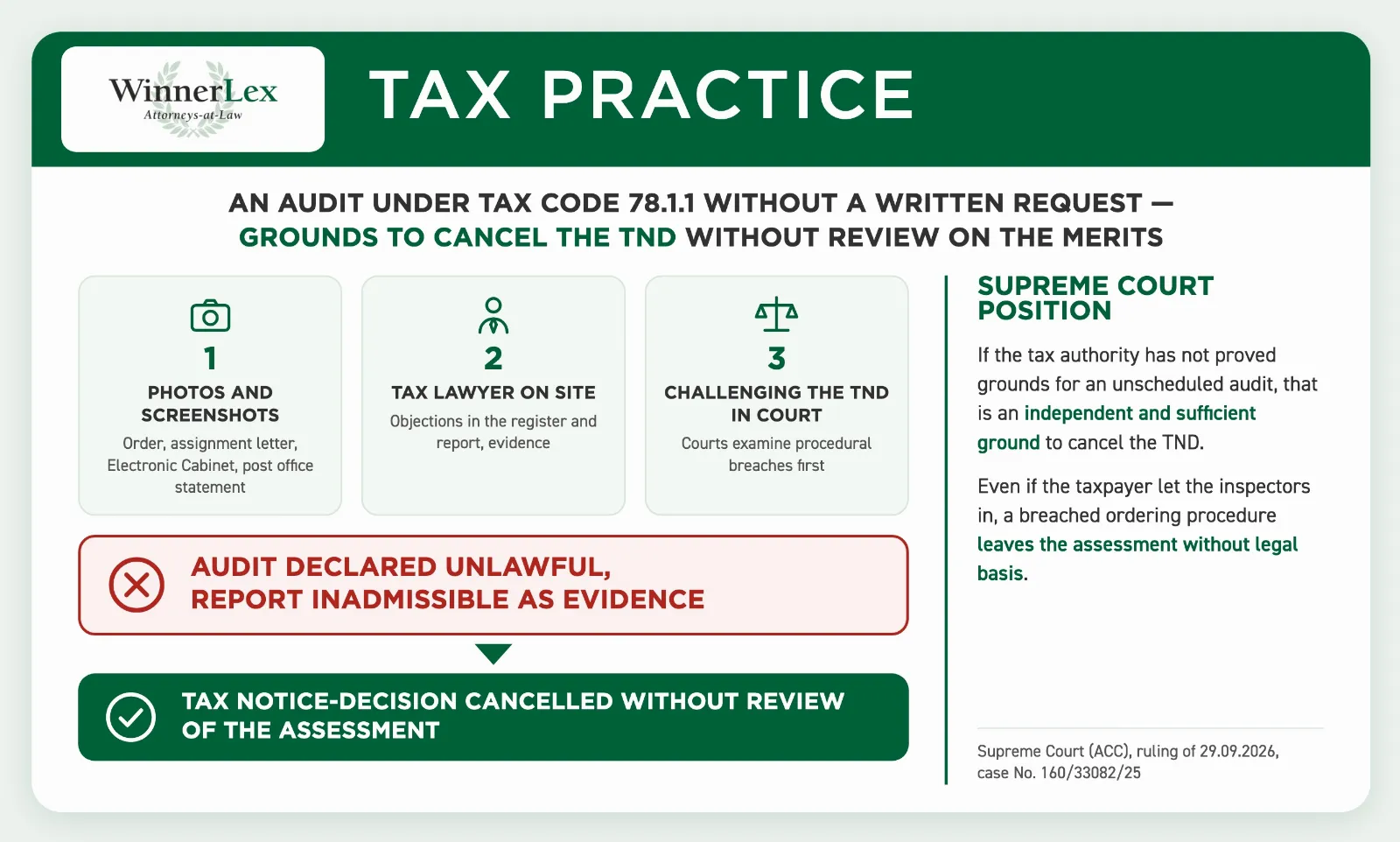
Businesses increasingly come to WinnerLex Law Firm with a worrying problem: tax inspectors start an unscheduled documentary audit under subparagraph 78.1.1 of paragraph 78.1 of Article 78 of the Tax Code of Ukraine while skipping a mandatory step — sending a written request first.
The law, however, clearly requires a combination of conditions for such an audit:
- the tax authority holds tax information indicating a breach of currency, tax or other legislation it is responsible for enforcing;
- the taxpayer has not provided written explanations and supporting documents in response to the authority's official request (which must specify the alleged breaches) within 15 working days of the day after receiving it.
An unexpected visit from inspectors relies on surprise and on catching the business owner off guard. In this article we set out what to do in that situation: how to record the inspectors' breaches properly, why ignoring the mandatory request deprives the audit of a legal basis and its results of legal force, and how the Supreme Court's clear position in favour of taxpayers helps to cancel unlawful tax notice-decisions (TNDs) in full.
The risk of refusing access: why you should not turn the inspectors away
When tax inspectors arrive without a prior request, the first impulse of a director or accountant is often to refuse them access outright. Refusal, however, is one of the most dangerous mistakes a taxpayer can make: it entitles the tax authority to seek an administrative arrest of the company's property and assets (Article 94 of the Tax Code of Ukraine).
To avoid putting the company's operations at risk and bringing the business to a halt, every step must be competent and procedurally sound.
Step-by-step: what to do while the inspectors are on site
To prove the State Tax Service's breach effectively in later court proceedings, the taxpayer must collect and properly document the evidence during the inspectors' visit itself.
If the audit order and the assignment letter name subparagraph 78.1.1 of paragraph 78.1 of Article 78 of the Tax Code of Ukraine as the ground, take the following steps at once:
- Photograph all documents.Take complete photos of the audit order and every assignment letter presented.
- Record the absence of a request in official registers and services:
- Screenshots from the taxpayer's Electronic Cabinet.Immediately take and save screenshots of all incoming documents and notifications, and print out the "Incoming/outgoing documents" section and the audits tab of the Electronic Cabinet. This confirms that no request for explanations within 15 days was sent to the taxpayer electronically.
- A written request to the post office (Ukrposhta).To rule out claims by the tax authority that a letter was "sent but returned", immediately submit an official written request to the post office (or courier service) serving the company's registered address. Ask for an official statement on whether any notice, registered letter or other mail from the tax authority has arrived at the company's address in recent months.
- Engage a tax lawyer (recommended).We recommend promptly engaging a lawyer to accompany your communication with the inspectors during their visit. A WinnerLex tax lawyer can present the legal position to the inspectors with reference to Supreme Court case law and our own successful practice, and in this way secure the abandonment of the audit on the spot. If the inspectors insist on proceeding, the lawyer will help you word and enter objections in the audit register, the assignment letter or the audit report correctly and prepare the evidence needed to cancel the TND later.
Why the State Tax Service's procedural breaches let the taxpayer win in court
Case law, including the position of the Administrative Court of Cassation within the Supreme Court, is unequivocal: courts examine procedural breaches committed by the tax authority in ordering and conducting an audit first. Once it is established that an audit was ordered in breach of the Tax Code of Ukraine (in particular, without the mandatory request under subparagraph 78.1.1), the courts declare the audit unlawful and cancel the tax notice-decisions issued on its results without examining the additional assessments on the merits.
In support of this position, we cite a recent ruling of the Administrative Court of Cassation within the Supreme Court of 29 September 2026 in case No. 160/33082/25.
- Parties:Vidrodzhennia LLC (plaintiff) v. the Main Department of the State Tax Service in Dnipropetrovsk Region (defendant).
- Subject of the dispute:a challenge to Order No. 5312-p of the Main Department of the State Tax Service in Dnipropetrovsk Region of 22 August 2025 "On conducting an unscheduled on-site documentary audit of Vidrodzhennia LLC" and to the audit results.
Examining the case, the Supreme Court, sitting as a panel of the Administrative Court of Cassation, found that the tax authority had not proved grounds for an unscheduled documentary audit under subparagraph 78.1.1 of paragraph 78.1 of Article 78 of the Tax Code of Ukraine: it submitted no evidence either of receiving tax information about a breach of law by the taxpayer or of sending the plaintiff a written request for explanations and supporting documents.
As the courts established, the tax authority's audit report referred to information from the National Bank of Ukraine (letters of 17 January 2025 No. 25-0005/4070 and of 18 February 2025 No. 25-0009/12372) about a breach of currency legislation. The proper procedure, however, was not followed.
The Court stressed that the tax authority's failure to prove grounds for an unscheduled documentary audit is a material breach of the procedure for ordering it, and is therefore an independent and sufficient ground for cancelling the tax notice-decision issued on its results.
Citing settled case law (Supreme Court rulings of 18 August 2021 in case No. 160/9277/19 and of 26 September 2024 in case No. 600/6022/23-a), the Court held that once a documentary audit is declared unlawful, there is no need to examine whether tax or other legislation was breached, and the tax notice-decisions issued on its results must be declared unlawful.
That is why, as soon as inspectors appear at the company, it is critical to establish at once whether the tax authority sent the mandatory written request, whether explanations were provided and how, and to record every procedural breach by the State Tax Service in a legally sound way.
The WinnerLex team has extensive practical experience in supporting tax audits, documenting procedural abuses and cancelling tax notice-decisions. An experienced tax lawyer will help you pass every stage of an audit correctly, build a proper evidence base for court and cancel unlawful additional assessments to protect your business.