 Kyiv, 6 Ivana Dracha St., of. 15


WinnerLex Attorneys-at-Law successfully defended an architectural bureau in the commercial court against a developer’s claim for recovery of an advance payment
23.06.2026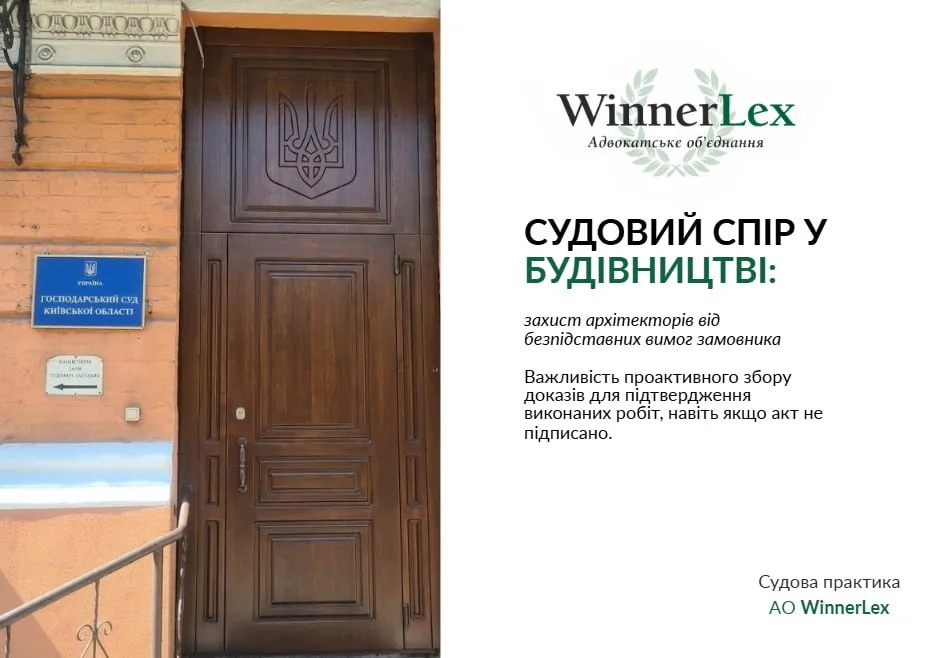
Is it possible to defeat a developer in a claim for recovery of an advance payment even before the first court hearing? The lawyers of WinnerLex proved that it is, and successfully defended an architectural bureau against the developer’s groundless demands for the return of the advance payment in the Commercial Court of the Kyiv Region. We proved that the work had been performed even in the absence of a signed final handover-and-acceptance act, which led to the claim being left without consideration at the plaintiff’s own initiative.
Why did a commercial dispute over recovery of the advance payment arise?
The client — an architectural bureau — turned to WinnerLex. The developer (the customer of the work) filed a claim with the court to recover from our client the advance payment made under a contract for the performance of design work. The claim was based on the assertion that the architectural bureau had allegedly failed to fulfil its obligation to develop the design documentation for the construction of a residential complex.
The plaintiff’s main argument was the absence of a final act of completed work signed by both parties. In fact, the documentation had been fully developed, and a residential complex had already been erected at the construction site. The customer avoided accepting and signing the act, seeking to use this as a formal basis for a refund.
Building the defence strategy and gathering evidence
The first document a defendant must file with the court is a statement of defence (a response to the claim). If there are grounds to object, then absolutely all objections must be set out in that response. All evidence supporting the defendant’s position must likewise be submitted together with the response — otherwise the court may simply refuse to admit it later. So we had to file all the evidence and objections within a short timeframe — less than 15 days from the date the client received the court ruling. That may seem like enough, but for complex construction cases it is a fairly short period, given that a client usually does not approach us on the very same day, and the body of evidence still has to be identified and collected. To ensure systematic protection of the client’s rights, our attorneys sent a series of attorney requests and gathered evidence of the actual performance of the work and its handover to the developer, namely:
- interim acts on the transfer of individual sections of the design documentation;
- expert reports on the review of the design documentation;
- permits for construction work;
- acts of readiness of the facility for operation;
- certificates confirming the acceptance into operation of completed construction projects.
These documents confirmed that the legal support for the construction of the facility and its commissioning had been carried out precisely on the basis of the design documentation developed by our client.
The outcome for the client — the claim against it was left without consideration
The objections to the claim, in the form of a statement of defence together with all the collected evidence, were filed with the court in good time.
After receiving our response, the plaintiff had five days to reply to it. But no reply ever came. Instead, a few days before the first court hearing, the plaintiff filed a motion with the commercial court to leave the claim without consideration. It became clear that, having reviewed the body of evidence provided by our attorneys and its legal reasoning, the plaintiff had quite rationally concluded that the claim had no further prospects in court. As a result, the Commercial Court of the Kyiv Region granted the developer-plaintiff’s motion by its ruling, and the case was terminated at the very outset.
The result of our work is a complete resolution of the dispute in the client’s favour without proceeding to trial: the architectural bureau’s reputation was preserved, time and nerves were saved, and — as a bonus — both the client and the attorneys were left in good spirits by how unexpectedly quickly and positively everything ended.